Participants will be introduced to the history, importance, and contemporary relevance of illustrating fish for scientific purposes. They will also gain the knowledge to both acquire and work with specimens in their own studio using best practices, tools and procedures.
Participants may select the Post Workshop Critique Option (+$50), which will allow them to send their finished illustration to Karen after the workshop for additional feedback and discussion (30 minutes via Zoom, phone, or in-person).
There is a one-day intermediate workshop on 26 September that would be a great follow-up to this workshop.
Recommended experience level: No prior experience needed
Materials List:
We will be working primarily with water-based colored pencils. I will be using Crayola watercolor pencils, but you’re more than welcome to use any water-based colored pencils (e.g., Caran d'Ache, Faber-Castell, etc.). Here’s a link to Blick’s selection. Generally, the base set will be 12 colors. You will need the 10 minus the black and the white.
For watercolor paper, what you have will work! Having said that, in general, the watercolor paper choice is the single most impactful choice you can make as far as the quality of the finished piece. My preference personally would be hot-press watercolor paper or Bristol paper(which is not watercolor paper, but works well given its smoothness). It is easier to find cold press watercolor paper, and that will work. The hot press has a smoother surface, and that’s what I usually choose for scientific illustration because the smoother surface, the more detail it will accept. Weight is also an important factor. The heavier the weight, the more the paper can withstand without buckling or damage. I will likely be using 300-pound, hot press watercolor paper this weekend.
For your water, a glass or cup of water will suffice. Also, have a rag or paper towel to clean your brush.
For brushes, you can use any small brush (size 1 or 2, round). An affordable, readily available brush like Winsor & Newton Cotman Watercolor Brushes will work fine. The Winsor & Newton Series 7 Kolinsky Sable Brushes are my favorite, and they last (but they are significantly more expensive).
For tracing paper, any tracing paper or vellum will work.
In terms of pencils, it’s good to have at least one soft graphite pencil (B) and one hard graphite (F or H) for transferring the line drawing.
For dissection trays, I noted on the Material’s List that you could purchase them online from a place like Carolina Biological (or even Amazon). I have a few purpose-built ones myself, but most of the ones I use for in-person classes are ones I made. To make your own, buy some paraffin wax. Gulf Wax Household Paraffin Wax is available at my grocery store, hardware store and places that sell canning goods. I use four 16 oz bars for one deep baking pan. It’s recommended to melt the wax using a double boiler method on the stove top and then pour it into the cake tray. Having said that, I usually do it in the oven given that I am lucky enough to have an oven that is very precise at low temps (120°F to 200°F). Regardless of how you melt the wax, then just set it on a level, heat resistant surface to cool. Please note, melting paraffin wax in the oven can be dangerous, so if you don’t have an oven with reliable low temp settings, stick to stove top or heat plate. Finally, if you don’t have/can’t make a dissection tray, a piece of foam and some pins will work, as we are simply pinning the fish and not doing an actual dissection.
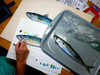
For your specimen, we will all be working with formalin preserved perch for this workshop. Please use the link to purchase your specimen directly from Carolina Biological. Select Plain, 7-9", and 1 per Bag for the options. The fish should cost $4.75+shipping.
Finally, for pins, if you have Handi-Pins or another pin designed for dissection, that’s great. Otherwise, most any stout pin will work, including kitchen pins and even straight pins.
 Loading... Please wait...




 19-20 September, $120.00 (https://stores.karentalbotartonline.com/virtual-illustrating-fishes-workshop-history-and-techniques-2-day-8-hours/))